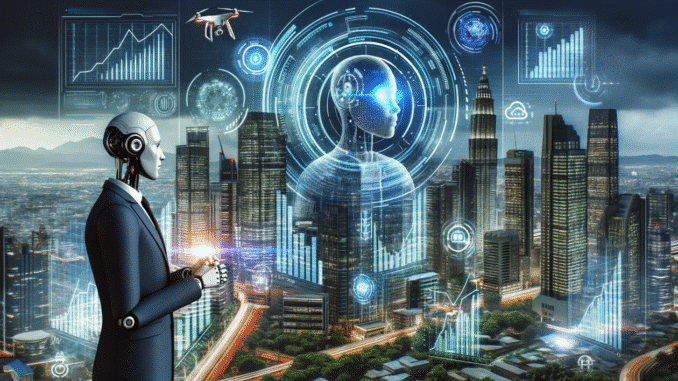
AI in financial forecasting combines big data and machine AI Is Transforming Financial Forecasting learning to analyze complicated variables, automate data collection, and generate more precise,AI Is Transforming Financial Forecasting dynamic, and real time forecasts. This helps firms make more educated, flexible decisions by decreasing manual labor, enabling quicker “what-if” scenario analysis, and offering more profound insights into market trends and risks. A high-tech update is underway for financial forecasting. Artificial intelligence (AI) is already being used by large corporations to analyze vast amounts of data and make remarkably accurate predictions about future economic events AI Is Transforming Financial Forecasting in 2025. To put it simply, artificial intelligence (AI) in financial forecasting refers to the application of machine learning algorithms and intelligent software to economic data to anticipate revenues, expenses, cash flow, and other metrics more quickly and precisely.
The significance of financial forecasting
Financial projections impact strategic decision-making, headcount management, company planning, and budgeting. Forecasting serves as the foundation for all of your employees’ economic decisions. Forecasting can help reduce the impact of unforeseen circumstances and provide growth prospects when conditions are right. However, finance teams struggle to create forecasts more often because they have to follow processes meant for quarterly or monthly tasks and need to combine past results, current performance, and future market predictions. AI Is Transforming Financial Forecasting. AI Is Transforming Financial Forecasting Effective forecasting can now begin as soon as the budget is implemented, thanks to the introduction of modern tools such as financial planning and analytics systems. This improvement is made possible by the fact that finance teams may now readily roll forward consolidated financial data, including actual, for ongoing monthly forecasting.AI Is Transforming Financial Forecasting.
Essential AI tools for ML, DL, NL, and predictive analytics
Neural networks, special methods for understanding language like transformers and statistical language models, and techniques like regression and decision trees are important AI technologies used in machine learning, deep learning, natural language processing, and predictive analytics. AI Is Transforming Financial Forecasting . These technologies process texts, search for patterns in data, and forecast future events AI Is Transforming Financial Forecasting. Three fundamental technologies Machine Learning (ML), Deep Learning (DL), and Natural Language Processing (NLP) form the basis of intelligent automation and decision-making inside an AI ecosystem. Despite their close relationship, these technologies have different applications, functions, and structures.
The Application of AI to Demand Forecasting
Accurate demand forecasting is now a survival skill rather than merely a strategic advantage at a time of unpredictability and complexity. For many years, supply chain experts have used static models, business intuition, and past sales data to forecast future demand AI is expected to transform financial forecasting AI Is Transforming Financial Forecasting. However, that strategy is becoming more and more disconnected from reality. Businesses are calling for forecasting systems that are smarter, faster, and more responsive due to global disruptions, changing customer expectations, supplier lead times, and an all-time high in SKU multiplication. Here comes artificial intelligence (AI) demand forecasting, a transformative technique that improves forecast accuracy, reduces supply chain interruption, and provides real time insights that are unmatched by conventional methods. This essay examines how artificial intelligence is changing demand forecasting, the reasons behind its popularity, and the factors supply chain executives should take into account when assessing AI powered solutions.
Processing data in financial markets in real time
In financial markets, real-time data processing entails analyzing continuous streams of real time data to facilitate prompt decision making for tasks like risk management, fraud detection, and algorithmic trading AI Is Transforming Financial Forecasting AI Is Transforming Financial Forecasting. To identify patterns and anomalies as they emerge, it entails continuously processing data that has been ingested from sources such as news services and market feeds and using analytics. Improved efficiency, better risk assessment, better fraud protection, and the capacity to offer more individualized customer services are some of the main advantages. As it is created, data is gathered from various sources, including news feeds, stock exchanges, and consumer transactions. Constant Processing To accommodate continuous information streams, data is handled in real time rather than in batches. Analytics in real time AI Is Transforming Financial Forecasting. As the data comes in, it is analyzed using methods like machine learning and time-series analysis to search for trends, patterns, or abnormalities.
Read Also: Sustainable Solutions for a Greener Future
Benefits of automation and efficiency
Increased Efficiency and Productivity. The ability of automation to work around the clock without getting exhausted is one of its main advantages. Robots and CNC equipment can work around the clock, offering higher production volumes and a quicker cycle than manual labor AI is set to transform financial forecasting. Automation is the process of using technology or machines to carry out jobs with little assistance from humans. The strategy aims to decrease human error, improve efficiency, and streamline procedures. Read this article to find out more about automation. AI Is Transforming Financial Forecasting
AI-based forecasting of ash flow
In contrast to conventional techniques, AI cash flow forecasting employs machine learning and AI Is Transforming Financial Forecasting predictive analytics to automate data analysis, spot trends, and produce more precise, real-time cash flow estimates AI Is Transforming Financial Forecasting. In order to create a more flexible and strategic financial picture, it does this by combining data from many sources, analyzing historical and current data, and taking into account outside variables AI Is Transforming Financial Forecasting. Neural networks, random forests, and ensemble models are examples of machine learning models that are used in AI driven cash flow forecasting. By analyzing enormous volumes of financial data and identifying minute patterns that human analysts might overlook, these models beat conventional statistical techniques.
Using AI to evaluate credit risk
By evaluating borrowers’ creditworthiness more quickly, accurately, and dynamically than traditional manual techniques, artificial intelligence (AI) is revolutionizing credit risk assessment. In order to enhance decision-making throughout the whole credit life cycle, AI models analyze enormous volumes of data, including information from unusual sources AI Is Transforming Financial Forecasting. It aids in locating possible hazards, evaluating their impact and likelihood, and creating suitable risk-reduction plans. AI is expected to transform financial forecasting. Economic turbulence has heightened financial institutions’ concerns about extending credit to high-risk borrowers. That’s why many companies have turned to artificial intelligence in credit risk assessment and management. Adopting AI technology proves to be the most practical way for financial institutions to reduce the risk of making fraudulent loans while simultaneously increasing the size of their customer base.
Identification and prevention of Fraud
In order to protect against fraud, fraud detection and prevention are complementary approaches. AI Is Transforming Financial Forecasting. While detection focuses on discovering previous or current fraudulent activity, prevention emphasizes proactive actions. While detection employs ongoing monitoring and analysis, frequently using AI and machine learning, to spot suspicious patterns and flag possible fraud, prevention is putting internal controls and procedures in place to stop fraud before it occurs AI Is Transforming Financial Forecasting. When combined, these tactics provide a strong framework that safeguards both people and organizations. By examining transaction data, behavior patterns, and abnormalities that don’t correspond with real users, artificial intelligence (AI) for fraud detection can identify phony accounts. Systems detect indications of identity theft, account takeover, or fraudulent activity by utilizing machine learning and AI-powered fraud detection. AI Is Transforming Financial Forecasting.
Forecasting commodity and currency prices
Forecasting currency and commodity prices entails applying a variety of analytical techniques to anticipate future price changes and exchange rates AI is expected to transform financial forecasting. These techniques often fall into technical analysis, which focuses on price movements fundamental analysis, which focuses on economic causes; and sophisticated quantitative models, which include machine learning.
Techniques for Forecasting
- Basic Analysis
- Factors related to currency
- Factor of Commodity
- Technical Evaluation
- Quantitative Frameworks
- Econometric Models for Time Series Analysis
- AI and Machine Learning (ML) Forecasting for the Future
AI-based forecasting patterns in the future
Some future developments in AI-based forecasting include a move to real time data and autonomous systems, integration with IoT devices, and increased use of explainable AI (XAI) for transparency and trust. Additionally,AI Is Transforming Financial Forecasting AI will continue to be used in specialized fields like personalized medical predictions and develop into a strategic business partner by enabling complex scenario planning and offering more nuanced insights AI Is Transforming Financial Forecasting. AI forecasting is the use of AI and machine learning algorithms to look at past data and make predictions about what will happen in the future. AI Is Transforming Financial Forecasting.
Human-AI collaboration’s role
Human-AI cooperation is the process by which artificial intelligence and humans cooperate to accomplish goals that neither could complete on its own. While humans supply critical thinking, creativity, and ethical judgment, AI is responsible for jobs like data processing and repetitive operations AI Is Transforming Financial Forecasting. This collaboration enhances human potential, resulting in improved decision-making, enhanced productivity, and more creativity in various domains. In recent years, a number of instances have surfaced showing how people use AI to support their jobs across various industries. By analyzing vast volumes of data, artificial intelligence (AI) can assist in the diagnosis of diseases in the healthcare industry. Medical professionals can then use their experience to assess the results and make final diagnostic choices.AI Is Transforming Financial Forecasting.
Conclusion
In conclusion, for a corporation to be stable, grow, and manage risk, financial forecasting is essential AI Is Transforming Financial Forecasting. It assists companies with revenue planning, cost control, and obtaining capital for growth. Economic forecasting has seen a significant transformation thanks to artificial intelligence (AI), which has transformed it from a static, historical process to a dynamic, real-time, and more accurate strategic function AI Is Transforming Financial Forecasting. AI models are better than traditional methods at analyzing large and complicated data and finding hidden patterns that people might miss, thanks to advanced techniques like machine learning, deep learning, and natural language processing AI Is Transforming Financial Forecasting. In simple terms, AI in financial forecasting means applying machine learning algorithms and smart software to financial data so you can forecast revenues, expenses, cash flow, and other metrics faster and more accurately. This isn’t just theory or hype, either; it’s already happening.